


 Financing

7/24/2026
Water Softener vs. Whole-Home Filtration for DFW Homes
Share:


The short answer: a water softener removes hardness minerals — calcium and magnesium — so scale stops forming in your water heater, fixtures, and appliances. A whole-home filter removes things you can taste, smell, or don’t want to drink — chlorine, sediment, and other contaminants — but leaves hardness untouched. If your complaint is scale, spotted glassware, and short water heater life, you want a softener. If it’s taste, odor, or drinking-water quality, you want filtration. Plenty of Dallas–Fort Worth homes install both, in series.
What does each one actually do?
| Factor | Water softener (ion exchange) | Whole-home filtration |
|---|---|---|
| Primary job | Removes calcium & magnesium (hardness) | Reduces chlorine, sediment, taste & odor compounds |
| Stops scale in the water heater | Yes — this is the point | No |
| Improves taste and smell | Not directly | Yes — this is the point |
| Protects appliances & fixtures | Yes — dishwasher, washer, faucets, shower heads | Indirectly (sediment only) |
| Ongoing consumable | Salt (roughly a bag a month, varies) | Filter media / cartridge changes |
| Typical maintenance | Keep the brine tank filled; periodic service | Replace media on schedule |
| Effect on soap use | Noticeably less soap and detergent needed | No change |
| Who it suits | Homes fighting scale, spotting, short heater life | Homes unhappy with taste, chlorine smell, sediment |
Which problem do I actually have?
Read your symptoms:
- White crust on faucets, cloudy glassware, soap that won’t lather, water heaters dying early — that’s hardness. Softener.
- Chlorine or pool smell, flat or metallic taste, visible grit in an aerator — that’s a filtration issue.
- Both sets of symptoms — that’s most DFW homes with an opinion about their water, and it’s why the two systems are commonly plumbed together, filter first, then softener.
Your city’s annual water quality report tells you the hardness number and what’s in the supply before you spend anything — start there. The full picture on hardness is in what DFW’s hard water does to your plumbing.
What about salt-free ‘conditioners’?
Salt-free systems don’t remove hardness; they alter how the minerals crystallize so scale is less likely to stick. They’re a reasonable option when you want scale protection without a brine tank or a drain connection, but they won’t give you the slick-feeling water, reduced soap use, or spot-free glassware a true softener does. Be skeptical of any product marketed as a softener that requires no salt and no regeneration — the physics are different, and honest manufacturers say so.
What does installation involve?
Both systems tie into the main line where water enters the house, typically in a garage or utility area. A softener also needs a drain for regeneration discharge and a power outlet. Sizing matters: undersized equipment regenerates constantly and wears out early, oversized equipment wastes salt and money. Tioga sizes the system to your household’s water use and measured hardness, then quotes the installation flat-rate in writing before starting — no equipment gets ordered on a guess.
Frequently asked questions
Do I need both a softener and a filter?
Only if you have both problems. Hardness and taste/odor are separate issues — test first, then buy the equipment that addresses what your water actually contains.
Does a softener remove chlorine?
No. A softener exchanges hardness minerals for sodium; chlorine reduction requires carbon filtration.
Is softened water safe to drink?
Yes for most people. Softening adds a small amount of sodium; households on strict sodium restriction sometimes leave the kitchen cold tap unsoftened or add a drinking-water filter at the sink.
Will a softener extend my water heater’s life?
It removes the primary cause of sediment buildup, which is the main reason DFW tanks fail early. It doesn’t replace annual flushing, but it makes flushing far less of a losing battle.
How much does installation cost?
It depends on the equipment and how your plumbing is configured. Tioga quotes softener and filtration installations flat-rate in writing after evaluating your water and your setup — our general ranges are on the pricing page.
Can I install one myself?
Whole-home equipment ties into your main supply and, for a softener, a drain — work that in most DFW jurisdictions falls under plumbing code and inspection. A failed DIY tie-in is a leak on your main line, which is a bad place to learn.
Next step: get your water tested and a firm quote
The right answer starts with a number, not a sales pitch. Have your hardness measured and your setup evaluated, then get the equipment options priced flat-rate in writing.
Book a water treatment evaluation with Tioga →
Related reading
- Water softener installation in DFW — our service page
- Water filtration systems in DFW — our service page
- What DFW’s hard water does to your plumbing
- Tank vs. tankless water heater cost in DFW
Share:
Taking a bite out of Your Plumbing needs
 817-484-5356
Other Plumbing Services
Taking a bite out ofYour Plumbing needs
What Are the Disadvantages of an Indirect Water Heater When Upgrading Home Systems?
Navigating System Upgrades and Heavy Cooling Loads Your air conditioner is running non-stop to fight off the afternoon heat, but every time the compressor kicks on, the lights in your living room dim. In our years of keeping homes comfortable across Hurst TX, the team at Tioga Plumbing has found that when you start making... Read more »
Summer Home Maintenance FAQ: Managing AC Electrical Loads and Water Heater Strain
Are Your Home Systems Ready for the Summer Heat? Is your air conditioner running nonstop, but your electrical panel keeps shutting it down? When putting together a seasonal home maintenance checklist, our team at Tioga Plumbing notices that most homeowners focus entirely on changing air filters and cleaning gutters. However, the extreme demands placed on... Read more »

Troubleshooting Tripped Breakers: Is It Your AC or Your Electrical Panel?
The Myth of the Broken AC During a Heatwave When our dispatch team at Tioga Plumbing receives frantic calls on a scorching afternoon, most people believe that because their lights dimmed or the power abruptly cut out, their air conditioner has completely failed. However, when you are looking for reliable home maintenance tips and troubleshooting... Read more »
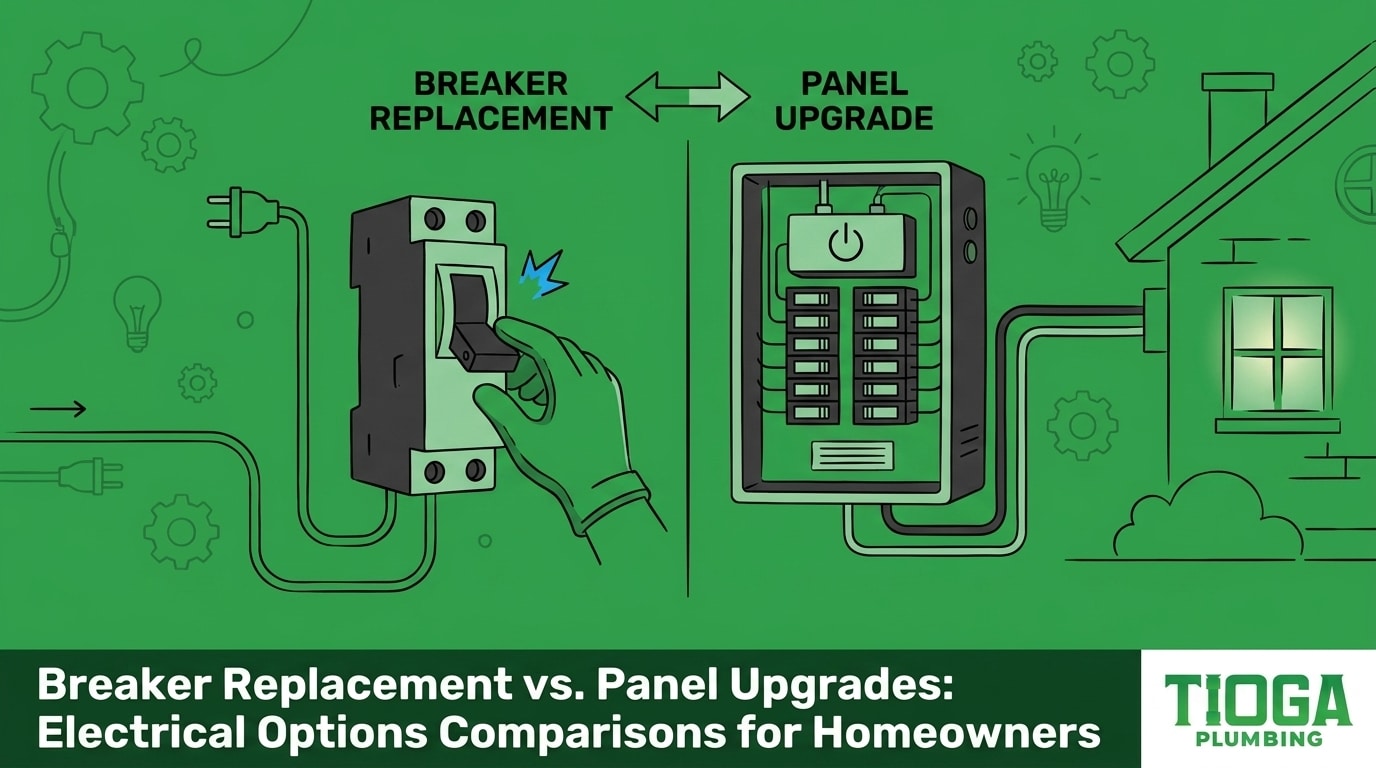
Breaker Replacement vs. Panel Upgrades: Electrical Options Comparisons for Homeowners
Is Your AC Constantly Tripping the Breaker in the Texas Heat? Are you finding yourself standing in front of your electrical panel every afternoon, flipping a tripped breaker just to keep your house cool? Losing your air conditioning during the July peak summer heat is more than just a minor inconvenience; it is a serious... Read more »
Got a $3,000+ Plumbing Quote? Get a Free Second Opinion
If another plumber handed you a quote of $3,000 or more, Tioga will come look at the same job for free and give you a written second opinion — even when the answer is that their price was fair.
Is the Gator Family Membership Worth $149 a Year?
One plan, $149 a year, ten inclusions. We do the arithmetic honestly — including who shouldn't buy it — and show where the membership pays for itself on a single service call.
How Plumbing Financing Works at Tioga (Step by Step)
Six steps from 'I can't pay for this today' to a scheduled repair. Tioga finances through Service Finance Company and Synchrony — a one-minute application that starts with a soft credit pull.
Water Softener vs. Whole-Home Filtration for DFW Homes
They solve different problems, and buying the wrong one is the most common water-treatment mistake we see. A side-by-side of what each removes, what it costs to run, and which DFW homes need both.
Drain Cleaning Cost in DFW: Auger vs. Hydro-Jetting
$185–$325 to auger one fixture, $285–$550 to clear a sewer main, $650–$1,200 to hydro-jet a lateral. Which one your symptoms call for, and why the cheapest option is sometimes the expensive one.

Taking a bite out ofYour Plumbing needs
We make fixing your home easier than ever. Whether it’s a leaky pipe, faulty wiring, or an urgent repair, our experts deliver fast, reliable solutions you can count on.