


 Financing

7/27/2026
Breaker Replacement vs. Panel Upgrades: Electrical Options Comparisons for Homeowners
Share:


Is Your AC Constantly Tripping the Breaker in the Texas Heat?
Are you finding yourself standing in front of your electrical panel every afternoon, flipping a tripped breaker just to keep your house cool? Losing your air conditioning during the July peak summer heat is more than just a minor inconvenience; it is a serious disruption to your daily life. Many people immediately assume their HVAC system is failing when the cold air stops flowing. However, the true bottleneck is frequently an outdated electrical panel that physically cannot sustain the amperage required during peak temperature days. When navigating electrical options comparisons for homeowners, the most critical decision often comes down to knowing whether you need a simple, single-breaker replacement or a comprehensive whole-home panel upgrade.
For comprehensive help with your home’s vital systems, explore our plumbing and electrical services to see how we keep things running safely and efficiently.
Understanding the root cause of these nuisance trips is the first step toward restoring your home’s reliability. A tripping breaker is actually doing exactly what it was designed to do: protecting your home from an electrical fire by cutting the power when a circuit becomes overloaded. But when it happens repeatedly, it indicates a fundamental mismatch between the power your home requires and the power your system can safely deliver. Addressing this issue promptly is essential for both your comfort and your property’s safety.
The Science of Continuous Electrical Loads and Summer Cooling
To understand why your air conditioner struggles specifically during the hottest months, we have to look at how electrical loads are classified. In the electrical trade, a “continuous load” is defined as any appliance or device that runs at maximum current for three hours or more. During a Texas summer, your central air conditioning unit easily meets this definition, often running from late morning until well after sunset without a break. This sustained demand places incredible stress on your home’s electrical infrastructure.
The National Electrical Code (NEC) has a very specific safety guideline known as the 80% rule. This rule dictates that a circuit breaker should only handle 80% of its maximum rating for continuous loads. For example, if your air conditioner is on a standard 20-amp circuit, it should not draw more than 16 amps continuously. If the unit draws 18 amps, the breaker might hold for a short time, but the sustained draw will eventually cause it to trip. This safety margin exists to prevent the wiring inside your walls from overheating, melting its insulation, and potentially starting a fire.
This situation is heavily influenced by the environment. Sustained high ambient temperatures in Texas summers exacerbate breaker sensitivity, causing them to trip faster than they would in cooler months. Most circuit breakers use a thermal-magnetic tripping mechanism. The “thermal” portion relies on a bimetallic strip that bends as it heats up from the electrical current passing through it. When the ambient air around the electrical panel is already sweltering, the breaker starts at a higher baseline temperature. It takes far less electrical load to generate the remaining heat necessary to bend the strip and trip the switch.
This dynamic is especially problematic in Hurst TX older residential neighborhoods. Many of these homes still rely on their original electrical panels, which were designed in an era before multiple televisions, home offices, smart appliances, and high-efficiency HVAC systems were standard. These legacy systems simply were not built to handle the simultaneous electrical draw of modern living, making continuous load trips an almost guaranteed occurrence during a heatwave.
When is a Simple Circuit Breaker Replacement the Right Option?
Not every tripped breaker means you need to tear out your entire electrical system. In some specific, limited scenarios, replacing a single circuit breaker is a safe and highly effective solution. Circuit breakers are mechanical devices, and like any mechanical device, they degrade over time. Years of heat exposure, slight power surges, and repeated tripping can weaken the internal springs and contacts. When this happens, the breaker may begin tripping well below its rated capacity.
A simple breaker replacement is only a viable option if the total panel capacity is still sufficient for your home’s overall needs. If you have a modern panel with plenty of overhead, but one specific breaker keeps failing, localized replacement is the logical next step. A licensed professional will test the actual amperage draw of the circuit while the appliance is running. If the air conditioner is drawing a normal amount of power but the breaker is still tripping, the breaker itself is the culprit.
A critical warning for homeowners: You must never attempt the dangerous DIY practice of simply installing a larger breaker on an undersized wire. If a 20-amp breaker is tripping, swapping it for a 30-amp breaker without upgrading the wiring is a severe fire hazard. The breaker is sized to protect the wire. If you allow 30 amps of current to flow through a wire rated for only 20 amps, the wire will overheat and catch fire long before the new, larger breaker ever trips. Always leave breaker sizing and replacement to licensed professionals.
Signs of Normal Breaker Wear and Tear
If you suspect a localized issue with a single breaker rather than a systemic panel failure, there are several physical indicators a professional will look for:
- Physical looseness in the switch: If the breaker handle feels spongy, loose, or fails to click firmly into the “on” or “off” position, the internal mechanisms have likely worn out.
- Tripping immediately upon reset: If you reset the breaker and it instantly snaps back to the tripped position—even when all appliances on that circuit are turned off—the breaker is likely faulty or detecting a hard short circuit.
- Visible age-related degradation: Signs of scorching, a burning plastic smell near the panel, or visible rust and corrosion on the breaker contacts indicate immediate replacement is necessary.
- Warm to the touch: While breakers can get slightly warm under heavy load, a breaker that is hot to the touch is a sign of internal resistance and impending failure.
Signs Your Home Requires a Full Electrical Panel Upgrade
When the electrical issues in your home extend beyond a single faulty switch, you are likely looking at a systemic capacity problem. Upgrading your electrical panel is not just about convenience; it is a critical investment in your home’s safety and property value. Older panels, particularly those installed decades ago, are often fundamentally incompatible with the demands of modern electrical codes and high-draw appliances.
One of the most obvious signs of an overloaded panel is systemic power fluctuation. If your living room lights dim significantly every time the air conditioner kicks on, your system is struggling to deliver the necessary surge of startup power. You might also notice a persistent buzzing or humming sound coming directly from the panel, which indicates arcing or severe overloading. Frequent multi-circuit trips—where different breakers trip on different days—are another strong indicator that your total home electrical demand is pushing the main breaker to its absolute limit.
Upgrading to a higher capacity ensures your home can safely distribute power to heavy-draw appliances without overheating the main service lines. When evaluating your 100-amp vs 200-amp sustained load capacity, the math quickly reveals the limitations of older systems. A 100-amp panel can safely provide 80 amps of continuous load. Between a modern HVAC system, an electric water heater, a clothes dryer, and an electric oven, a home can easily demand more than 80 amps simultaneously, leaving absolutely no overhead for lighting, computers, or refrigeration.
Comparing 100-Amp vs. 200-Amp Service
Understanding the difference in capacity is crucial when deciding whether to upgrade your home’s electrical infrastructure.
| Feature | 100-Amp Panel (Legacy) | 200-Amp Panel (Modern Standard) |
|---|---|---|
| Continuous Load Capacity | 80 Amps maximum safe continuous draw. | 160 Amps maximum safe continuous draw. |
| Best Suited For | Small homes with gas heating, gas water heaters, and minimal electronics. | Modern homes with central AC, electric appliances, and home offices. |
| Summer AC Performance | Highly susceptible to nuisance tripping during peak heatwaves. | Provides ample overhead to run AC continuously without stressing the system. |
| Future Expansion | Virtually no capacity for adding EV chargers, hot tubs, or additions. | Plenty of physical space and electrical capacity for future home upgrades. |

How Major Plumbing and HVAC Appliances Impact Electrical Capacity
It is crucial to remember that your air conditioner does not operate in a vacuum. It shares the electrical panel with every other system in your home. Evaluating your electrical capacity requires a holistic look at your entire property, particularly when you are considering upgrading other major appliances. High-efficiency modern appliances are fantastic for reducing overall energy consumption, but they often require significant dedicated electrical circuits that older panels simply cannot support.
For example, transitioning from traditional gas appliances to modern electric alternatives dramatically alters your home’s electrical load profile. If you are currently evaluating the tank vs. tankless water heater cost, you must also factor in the electrical requirements. An electric tankless water heater requires a massive amount of instantaneous power to heat water on demand—often requiring two or three dedicated high-amperage breakers all on its own. If you try to install a system like this on a legacy 100-amp panel, you will instantly overload the main breaker the first time you take a shower while the air conditioner is running.
Working with a company that provides dual plumbing and electrical expertise means you don’t have to coordinate between two separate contractors when evaluating how a new water heater, pool pump, or HVAC system will impact your electrical panel. A comprehensive home evaluation ensures that all your major systems can coexist peacefully. Coordinating trades for home upgrades prevents electrical bottlenecks down the line, ensuring that your new high-efficiency plumbing fixture doesn’t inadvertently cause your air conditioner to lose power during the hottest week of the year.
Frequently Asked Questions About Electrical Panels and Breakers
Why does my AC keep tripping the breaker in summer?
Your AC trips the breaker in summer because it operates as a continuous load during extreme heat, drawing maximum amperage for hours on end. When the ambient temperature is high, older breakers become more sensitive to this sustained heat and trip faster to prevent wire damage. If your panel is outdated, the combined load of the AC and other appliances exceeds the system’s safe operating limits.
Can I just replace a circuit breaker instead of the panel?
You can replace a single circuit breaker if the issue is localized to a faulty, worn-out switch and your total panel capacity is still sufficient for your home’s needs. However, if the breaker is tripping because the circuit is genuinely overloaded, or if your home lacks the overall amperage to support your appliances, a new breaker will not solve the problem. A professional load calculation is required to determine the correct path forward.
How do I know if my electrical panel is overloaded?
An overloaded electrical panel typically presents clear warning signs, such as lights dimming when major appliances turn on, frequent tripping of multiple different breakers, or a faint buzzing sound coming from the panel box. You may also notice that the panel itself feels warm to the touch. If you experience any of these symptoms, it indicates your home is drawing more power than the panel can safely distribute.
What causes power fluctuations in a house when the AC turns on?
Power fluctuations, like dimming lights, occur when the AC compressor first starts up because it requires a massive surge of electricity—often double its normal running amperage—to get moving. If your electrical panel is undersized or your main service lines are outdated, this sudden draw starves the rest of the house of power for a split second. Upgrading your panel capacity or installing a hard start kit on the AC can resolve this issue.
Is it safe to reset a tripped breaker repeatedly?
No, it is highly dangerous to repeatedly reset a tripped breaker without investigating the cause. A breaker trips to protect your home from overheating wires and potential electrical fires. Forcing it back on repeatedly pushes electrical current through a compromised circuit, which can melt wire insulation and destroy the breaker’s internal safety mechanisms.
How long does an electrical panel upgrade take?
A professional electrical panel upgrade typically takes a full day to complete, usually ranging from six to eight hours depending on the complexity of the home’s wiring. During this time, your home’s power will be completely shut off while the old panel is removed and the new hardware is installed and grounded. The process also involves coordination with your local utility company and municipal inspectors to ensure everything meets current safety codes.
Secure Your Home’s Electrical Reliability This Summer
Dealing with unexpected power loss during the peak of summer is stressful, but understanding your electrical system gives you the power to make informed, safe decisions. Whether your home simply needs a localized breaker replacement due to normal wear and tear, or a comprehensive panel upgrade to safely handle the continuous load of modern appliances, guessing is never worth the risk to your property. Upgrading to a properly sized electrical system provides ultimate peace of mind, ensuring your air conditioning and plumbing systems run flawlessly no matter how high the temperature climbs.
When you are ready to stop resetting switches and want a clear, safety-focused evaluation of your home’s sustained load capacity, contact our team. We will provide a thorough assessment to ensure your electrical infrastructure is fully equipped to handle whatever the season brings.
Share:
Taking a bite out of Your Plumbing needs
 817-484-5356
Other Plumbing Services
Taking a bite out ofYour Plumbing needs
What Are the Disadvantages of an Indirect Water Heater When Upgrading Home Systems?
Navigating System Upgrades and Heavy Cooling Loads Your air conditioner is running non-stop to fight off the afternoon heat, but every time the compressor kicks on, the lights in your living room dim. In our years of keeping homes comfortable across Hurst TX, the team at Tioga Plumbing has found that when you start making... Read more »
Summer Home Maintenance FAQ: Managing AC Electrical Loads and Water Heater Strain
Are Your Home Systems Ready for the Summer Heat? Is your air conditioner running nonstop, but your electrical panel keeps shutting it down? When putting together a seasonal home maintenance checklist, our team at Tioga Plumbing notices that most homeowners focus entirely on changing air filters and cleaning gutters. However, the extreme demands placed on... Read more »
Troubleshooting Tripped Breakers: Is It Your AC or Your Electrical Panel?
The Myth of the Broken AC During a Heatwave When our dispatch team at Tioga Plumbing receives frantic calls on a scorching afternoon, most people believe that because their lights dimmed or the power abruptly cut out, their air conditioner has completely failed. However, when you are looking for reliable home maintenance tips and troubleshooting... Read more »
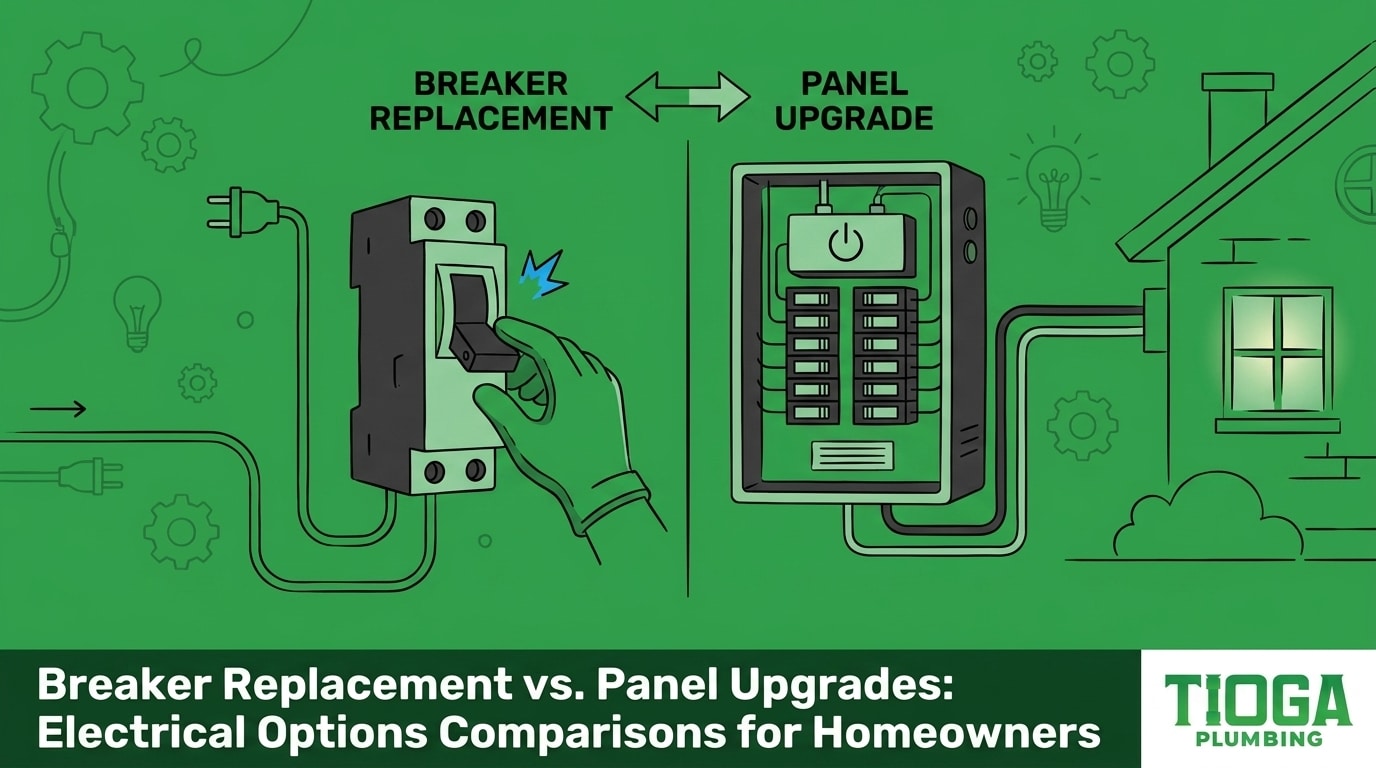
Breaker Replacement vs. Panel Upgrades: Electrical Options Comparisons for Homeowners
Is Your AC Constantly Tripping the Breaker in the Texas Heat? Are you finding yourself standing in front of your electrical panel every afternoon, flipping a tripped breaker just to keep your house cool? Losing your air conditioning during the July peak summer heat is more than just a minor inconvenience; it is a serious... Read more »
Got a $3,000+ Plumbing Quote? Get a Free Second Opinion
If another plumber handed you a quote of $3,000 or more, Tioga will come look at the same job for free and give you a written second opinion — even when the answer is that their price was fair.
Is the Gator Family Membership Worth $149 a Year?
One plan, $149 a year, ten inclusions. We do the arithmetic honestly — including who shouldn't buy it — and show where the membership pays for itself on a single service call.
How Plumbing Financing Works at Tioga (Step by Step)
Six steps from 'I can't pay for this today' to a scheduled repair. Tioga finances through Service Finance Company and Synchrony — a one-minute application that starts with a soft credit pull.
Water Softener vs. Whole-Home Filtration for DFW Homes
They solve different problems, and buying the wrong one is the most common water-treatment mistake we see. A side-by-side of what each removes, what it costs to run, and which DFW homes need both.
Drain Cleaning Cost in DFW: Auger vs. Hydro-Jetting
$185–$325 to auger one fixture, $285–$550 to clear a sewer main, $650–$1,200 to hydro-jet a lateral. Which one your symptoms call for, and why the cheapest option is sometimes the expensive one.
Taking a bite out ofYour Plumbing needs
We make fixing your home easier than ever. Whether it’s a leaky pipe, faulty wiring, or an urgent repair, our experts deliver fast, reliable solutions you can count on.