


 Financing

7/30/2026
What Are the Disadvantages of an Indirect Water Heater When Upgrading Home Systems?
Share:


Navigating System Upgrades and Heavy Cooling Loads
Your air conditioner is running non-stop to fight off the afternoon heat, but every time the compressor kicks on, the lights in your living room dim. In our years of keeping homes comfortable across Hurst TX, the team at Tioga Plumbing has found that when you start making options comparisons for homeowners regarding system upgrades, evaluating plumbing appliances often reveals hidden electrical bottlenecks. Understanding the disadvantages of an indirect water heater is a perfect example of how one outdated system can impact your entire home. You might think you just need a quick fix for a tripping breaker, but our technicians know these symptoms usually point to a much larger capacity issue.
Our professionals frequently service houses in older Hurst TX neighborhoods that were built with electrical systems designed for a different era. Decades ago, families did not rely on massive central cooling systems, multiple refrigerators, and high-draw electric water heaters all running simultaneously. Today, when your AC engages, it pulls a massive surge of power called “inrush current.” If your home’s electrical panel is already struggling to keep up with everyday demands, that sudden surge is enough to cause flickering lights or a tripped breaker.
This overlap between your plumbing and electrical systems is exactly why holistic home care matters to us. When you schedule routine water heater maintenance and care, a thorough Tioga Plumbing professional does more than just flush a tank. We look at how the appliance interacts with your home’s infrastructure. If you currently rely on an older, indirect water heating system, upgrading to a modern alternative will drastically change your home’s electrical load. Before making any major changes, you need to understand exactly how these systems affect your daily comfort and safety.
Understanding the Disadvantages of an Indirect Water Heater
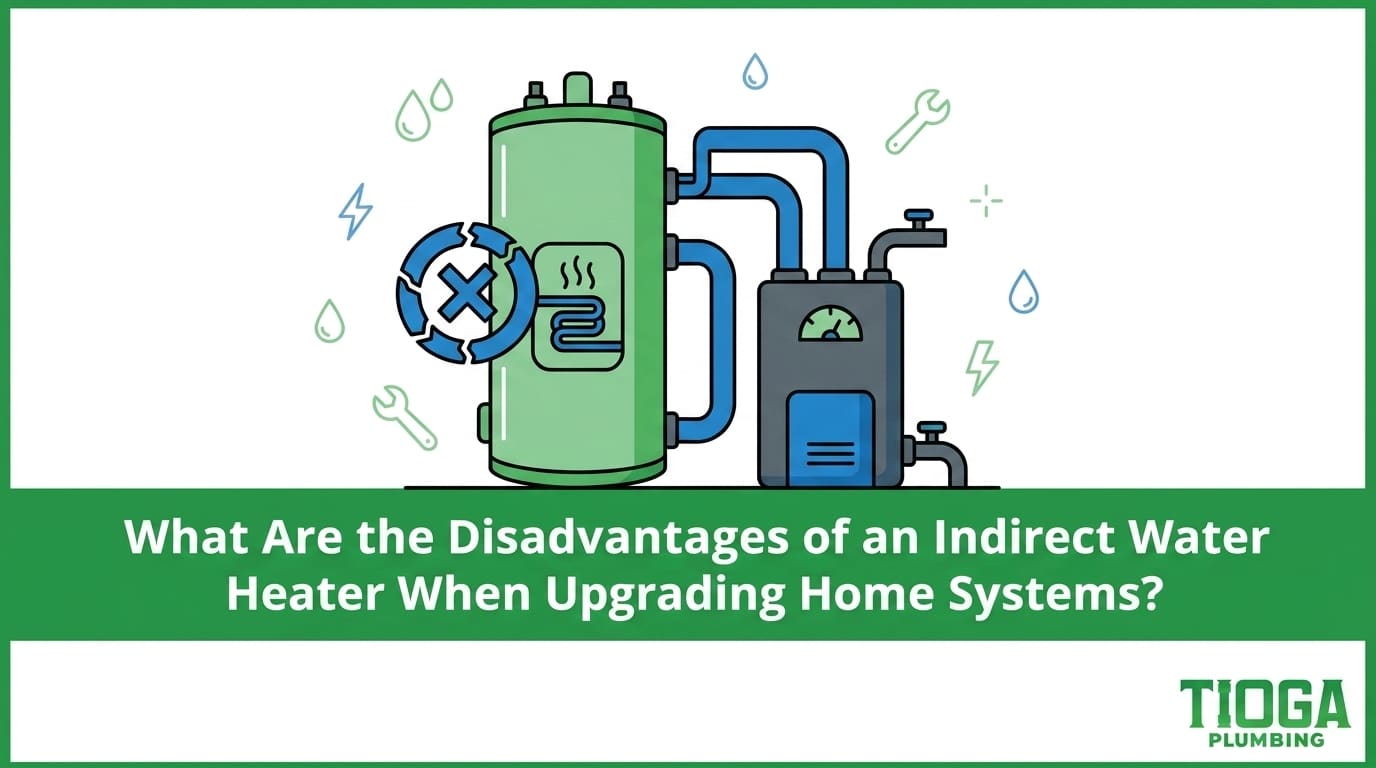
An indirect water heater does not have its own dedicated heating element or gas burner. Instead, it relies entirely on a space-heating boiler to generate hot water. The boiler heats a fluid, which then travels through a heat exchanger coil inside the water storage tank to warm your domestic water supply. While this setup is common in certain parts of the country, our local experts see significant drawbacks for homeowners in the DFW area.
Because we experience intense, long summers here in Texas, keeping a massive boiler system operational just to wash dishes or take a shower during the July peak summer heat is highly inefficient. Let’s break down the specific disadvantages our plumbers see when homeowners keep this outdated technology in a warm climate.
Boiler Dependency During Warm Months
The most glaring flaw of an indirect system is its total reliance on your home’s boiler. During the summer, your boiler should ideally be shut down to save energy and reduce wear and tear. However, an indirect water heater forces the boiler to fire up multiple times a day simply to maintain the temperature in your hot water tank.
- Wasted energy: Firing a large boiler to heat a small amount of water consumes far more fuel than a dedicated water heater would use.
- Unnecessary wear: Running heating equipment year-round accelerates component degradation and increases the frequency of breakdowns.
- Excess ambient heat: Boilers radiate heat. Running one in the middle of summer adds unwanted warmth to your home, forcing your AC to work even harder to cool the space.
Space and Installation Constraints
Indirect water heaters require a massive physical footprint. Because the system relies on two separate large components—the boiler itself and the bulky storage tank—it eats up valuable square footage in your utility room or garage. When our team consults with families comparing tank vs. tankless water heater costs in DFW, homeowners quickly notice how much space they can reclaim by ditching the boiler setup.
- Complex piping: These systems require intricate zoning controls, circulation pumps, and extensive piping to connect the boiler to the tank.
- Higher installation costs: The initial setup complexity means that replacing or repairing an indirect system requires significantly more labor and specialized parts.
- Vulnerability to single-point failure: If your boiler breaks down, you lose your hot water supply instantly.
Switching to Modern Alternatives: The Electrical Impact
Once homeowners recognize the inefficiency of running a boiler in the summer, they often look to modernize their plumbing. Replacing an indirect system frequently leads families to consider sleek, space-saving electric or gas tankless options. However, our electricians always stress that making this switch requires careful planning, especially if you live in one of the older Hurst TX neighborhoods with original utility infrastructure.
The hidden electrical load is a major factor when moving away from a boiler. If you choose an electric tankless water heater, you are introducing one of the highest-draw appliances available into your home. Unlike a traditional tank that slowly heats water over time, an electric tankless unit must flash-heat water on demand. Doing so requires a massive amount of instant amperage—often pulling over 100 amps all by itself while running.
If your home currently has a standard 100-amp or even a 150-amp electrical panel, adding an electric tankless system is mathematically impossible without an upgrade. Even if you choose a standard electric tank, the added load can push an aging panel to its breaking point. In our daily service calls, this is exactly why we see homeowners suddenly experience flickering lights and tripped breakers when the AC kicks on shortly after a plumbing upgrade. The panel simply does not have the capacity to handle the AC’s startup surge while the water heater is running.
Finding the right balance requires professional insight. At Tioga Plumbing, we frequently see homeowners in a bad situation with failing systems who just want a quick fix. In one recent case, our fast diagnosis found the root problem quickly, making a stressful situation better by addressing both the plumbing appliance and the electrical panel at the same time. If you are exploring tankless water heater alternatives, we highly recommend having your electrical capacity evaluated simultaneously to ensure your home can safely support the new technology.
Evaluating the Decision: Replacing a Breaker vs. Upgrading the Panel
When the air conditioner repeatedly trips a breaker, the most common homeowner reaction is to assume the breaker itself has gone bad. While breakers do wear out over time, they are designed to trip as a safety mechanism. They shut off the power to prevent wires from melting and starting a fire. If you simply replace a tripping breaker without investigating the root cause, you might be ignoring a severe whole-home capacity shortfall.
Modern homes with high-efficiency HVAC systems and modern plumbing appliances almost always require a 200-amp electrical panel to function safely. If your home is still running on older infrastructure, the panel’s main bus bar can become overloaded, leading to dangerous heat buildup. Understanding the difference between an isolated breaker failure and a whole-panel capacity issue is vital for your safety.
| Symptom Category | Isolated Breaker Issue | Whole-Panel Capacity Problem |
|---|---|---|
| Timing of Trips | Trips occur randomly, even when major appliances are turned off. | Trips happen specifically when the AC engages alongside other heavy appliances. |
| Visual Signs | The specific breaker switch shows physical wear, rust, or feels loose. | Lights dim or flicker across the entire house during appliance startup sequences. |
| Temperature | Only the single tripping breaker feels unusually hot to the touch. | The entire metal panel cover feels warm, indicating systemic overload. |
| Long-Term Solution | A quick, localized replacement of the single faulty breaker switch. | A comprehensive upgrade to a modern 200-amp electrical panel. |
Symptoms of an Isolated Breaker Issue
Circuit breakers are mechanical devices with internal springs and bimetallic strips. Over years of use, these internal components can weaken. If a breaker trips instantly when you reset it, or if it trips when there is almost no electrical load on the circuit, the breaker itself may be faulty. One of our licensed electricians can test the specific circuit to see if the breaker is tripping prematurely before the actual amperage limit is reached.
Signs of a Whole-Panel Capacity Shortfall
If your breaker only trips during the hottest part of the day when the AC is working its hardest, the breaker is likely doing its job perfectly—protecting you from an overloaded panel. When you combine the continuous draw of a struggling AC with a new electric water heater or kitchen appliances, the total amperage exceeds what the panel can safely distribute. Flickering lights, buzzing sounds from the breaker box, and breakers that trip only under heavy load are classic signs that your home desperately needs a capacity upgrade.

Safely Managing High-Draw Appliances Under Load
Ignoring electrical capacity warnings is incredibly dangerous. When a breaker trips, it is a literal cry for help from your home’s infrastructure. Repeatedly marching out to the garage to flip the breaker back on without diagnosing the underlying cause forces electricity through wires that are already overheated. Over time, this degrades the protective insulation around the wiring, drastically increasing the risk of an electrical fire.
This danger is magnified during the July peak summer heat. Sustained 100-degree days place maximum continuous strain on electrical systems. Because the ambient temperature in your garage or utility room is already sweltering, your electrical panel has no opportunity to cool down. When you add the continuous, heavy cooling loads of an air conditioner running for hours on end, capacity issues that might go unnoticed in cooler months become critical safety hazards in July.
The value of unified expertise: This is where working with a company that understands both sides of the wall becomes invaluable. Tioga Plumbing offers dual expertise in plumbing and electrical services, allowing our team to seamlessly transition a home from an outdated indirect water heater to a modern electric tankless system without needing to hire outside contractors. We evaluate the whole home as a single, interconnected ecosystem.
We approach every call with this comprehensive mindset. In one emergency situation involving severe drain and toilet backups, our team didn’t just apply a band-aid fix. We found the root cause immediately, addressed the hidden issue, and provided straightforward options to get the home functioning perfectly again. We apply that exact same diagnostic rigor when evaluating whether your home needs a simple breaker swap or a full panel upgrade to support repairing different types of water heaters and heavy AC loads.
Frequently Asked Questions About Water Heaters and Electrical Panels
When our technicians visit older Hurst TX neighborhoods, we frequently encounter the exact same overlapping issues when homeowners upgrade their plumbing and cooling systems. Below, we have compiled detailed answers to the most common questions our team receives regarding these critical home systems.
Why does my AC keep tripping the breaker in the summer?
Your air conditioner requires a massive surge of electricity to start the compressor, and high ambient temperatures increase this continuous electrical draw. When the outdoor temperature skyrockets, the AC has to work significantly harder and run longer to cool your home. If your electrical panel is already near its maximum capacity due to other appliances, that startup surge will overload the circuit and trip the breaker to prevent a fire.
Can I just replace a tripping breaker?
While a circuit breaker can mechanically fail over time, it usually trips because it is doing exactly what it was designed to do: protect an overloaded circuit. Replacing a breaker without properly testing the total panel load is a dangerous gamble. If the root cause is a lack of overall electrical capacity, putting in a new breaker will not solve the problem and may even mask a severe fire hazard.
How do I know if my electrical panel needs upgrading?
Visual and functional signs of an overloaded panel include lights that dim or flicker when major appliances turn on, buzzing sounds from the breaker box, and breakers that frequently trip under heavy load. Additionally, if your home still runs on a 100-amp service, it is highly likely you need an upgrade. Adding any modern, high-draw appliances like tankless water heaters or high-efficiency heat pumps will almost certainly require moving to a 200-amp system.
Is it dangerous if my AC breaker keeps tripping?
Yes, repeatedly resetting a tripping breaker is highly dangerous. Every time a circuit overloads, the wires heat up, which slowly degrades the protective plastic insulation surrounding them. Over time, this degraded insulation can lead to arcing, short circuits, and catastrophic electrical fires inside your walls.
What are the disadvantages of an indirect water heater in a warm climate?
The primary disadvantage is the severe inefficiency of relying on a space-heating boiler to generate hot water during intense summer heat. Because the system requires the boiler to fire up even when your home needs cooling, it wastes energy and adds unnecessary heat to your house. Furthermore, the combination of a boiler and a storage tank takes up a massive amount of valuable utility space.
Do I need an electrical upgrade for a tankless water heater?
If you are installing an electric tankless water heater, an electrical panel upgrade is almost always required for older homes. These units flash-heat water on demand, which requires an immense amount of instant amperage—often pulling over 100 amps alone. A standard older panel simply cannot support this load alongside an air conditioner without creating a severe safety hazard.
Make Confident Decisions for Your Home’s Systems
Addressing a tripping AC breaker or an inefficient, bulky indirect water heater requires looking at your home as a complete, interconnected system. You cannot safely upgrade a major plumbing appliance without understanding how it impacts your electrical load, and you cannot permanently fix a tripping breaker without assessing your home’s total energy demands.
Whether you need to step up to a modern 200-amp electrical panel to handle the summer heat, or you are finally ready to explore water heater repair or replacement to reclaim your utility room, professional guidance is essential. Upgrading your systems may also qualify you for generic energy efficiency incentives—such as federal tax credits or local utility rebates for qualifying installations—so we always advise checking with your utility provider or tax professional for current programs. Seek out a comprehensive evaluation from the licensed experts at Tioga Plumbing, who understand both plumbing and electrical systems. By taking a proactive, whole-home approach, you can ensure your family stays cool, comfortable, and safe all summer long.
Share:
Taking a bite out of Your Plumbing needs
 817-484-5356
Other Plumbing Services
Taking a bite out ofYour Plumbing needs
What Are the Disadvantages of an Indirect Water Heater When Upgrading Home Systems?
Navigating System Upgrades and Heavy Cooling Loads Your air conditioner is running non-stop to fight off the afternoon heat, but every time the compressor kicks on, the lights in your living room dim. In our years of keeping homes comfortable across Hurst TX, the team at Tioga Plumbing has found that when you start making... Read more »
Summer Home Maintenance FAQ: Managing AC Electrical Loads and Water Heater Strain
Are Your Home Systems Ready for the Summer Heat? Is your air conditioner running nonstop, but your electrical panel keeps shutting it down? When putting together a seasonal home maintenance checklist, our team at Tioga Plumbing notices that most homeowners focus entirely on changing air filters and cleaning gutters. However, the extreme demands placed on... Read more »
Troubleshooting Tripped Breakers: Is It Your AC or Your Electrical Panel?
The Myth of the Broken AC During a Heatwave When our dispatch team at Tioga Plumbing receives frantic calls on a scorching afternoon, most people believe that because their lights dimmed or the power abruptly cut out, their air conditioner has completely failed. However, when you are looking for reliable home maintenance tips and troubleshooting... Read more »
Breaker Replacement vs. Panel Upgrades: Electrical Options Comparisons for Homeowners
Is Your AC Constantly Tripping the Breaker in the Texas Heat? Are you finding yourself standing in front of your electrical panel every afternoon, flipping a tripped breaker just to keep your house cool? Losing your air conditioning during the July peak summer heat is more than just a minor inconvenience; it is a serious... Read more »
Got a $3,000+ Plumbing Quote? Get a Free Second Opinion
If another plumber handed you a quote of $3,000 or more, Tioga will come look at the same job for free and give you a written second opinion — even when the answer is that their price was fair.
Is the Gator Family Membership Worth $149 a Year?
One plan, $149 a year, ten inclusions. We do the arithmetic honestly — including who shouldn't buy it — and show where the membership pays for itself on a single service call.
How Plumbing Financing Works at Tioga (Step by Step)
Six steps from 'I can't pay for this today' to a scheduled repair. Tioga finances through Service Finance Company and Synchrony — a one-minute application that starts with a soft credit pull.
Water Softener vs. Whole-Home Filtration for DFW Homes
They solve different problems, and buying the wrong one is the most common water-treatment mistake we see. A side-by-side of what each removes, what it costs to run, and which DFW homes need both.
Drain Cleaning Cost in DFW: Auger vs. Hydro-Jetting
$185–$325 to auger one fixture, $285–$550 to clear a sewer main, $650–$1,200 to hydro-jet a lateral. Which one your symptoms call for, and why the cheapest option is sometimes the expensive one.
Taking a bite out ofYour Plumbing needs
We make fixing your home easier than ever. Whether it’s a leaky pipe, faulty wiring, or an urgent repair, our experts deliver fast, reliable solutions you can count on.