


 Financing

7/30/2026
Does a Pressure-Assisted Toilet Make Sense for Older Hurst Homes?
Share:


Are High-Pressure Flushes Safe for Mid-Century Plumbing?
Are you constantly reaching for the plunger, wondering: does a pressure-assisted toilet make sense for older Hurst homes? At Tioga Plumbing, it is a question our team hears frequently, especially during summer break when household bathroom usage peaks and your plumbing system is under maximum daily stress. You are tired of dealing with constant backups, and the promise of a commercial-grade, clog-eliminating flush sounds like the perfect permanent solution. However, before you upgrade your fixture, our plumbers strongly advise considering the hidden environment where it will operate.
The core decision point is whether this sudden, high-velocity force is a safe solution for your home, or a severe risk to the aging pipes hidden behind your walls and beneath your foundation. Finding the right balance requires understanding the current physical condition of your existing waste lines. Upgrading your fixtures without evaluating the infrastructure beneath them is a risky gamble. As you explore bathroom plumbing upgrades, we emphasize the critical need to look beyond the porcelain bowl and assess what your mid-century plumbing can actually handle safely.
The Appeal of the High-Velocity Flush
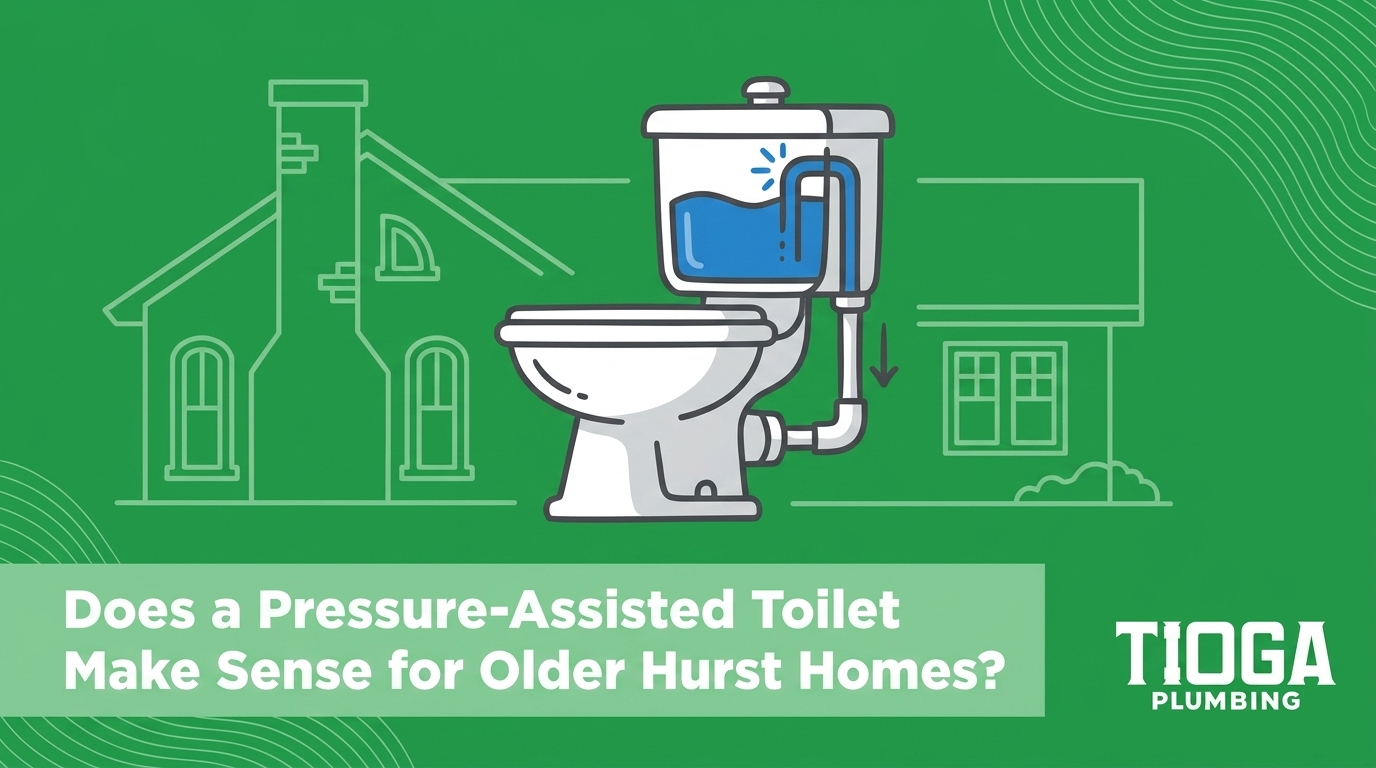
It is easy to see why homeowners are drawn to pressure-assisted models. Traditional toilets rely solely on gravity to pull waste down the drain. If the trapway is narrow or the water volume is low, clogs happen easily. Pressure-assisted toilets solve this by keeping water in a sealed internal tank under pressure. When you flush, that compressed air forces the water out in an explosive surge. It clears the bowl instantly and powerfully. But while our team sees this technology work flawlessly in modern commercial buildings and brand-new residential construction, dropping that same explosive force into a mid-century residential plumbing system introduces entirely new risks.
The Mechanics of Pressure-Assisted Flushes vs. Aging Cast Iron
To understand the risk, we always walk our customers through the technical interaction between modern high-pressure flush mechanisms and degraded mid-century pipes. Pressure-assisted toilets use compressed air to force water into the bowl, creating a sudden, powerful spike in pressure that travels rapidly down your drain line. Water is heavy and non-compressible, which means that sudden burst of speed acts like a physical shockwave moving through your plumbing.
Contrast this modern technology with the reality of 1950s-1970s mid-century builds with original cast iron pipes. In our decades of experience servicing older Hurst neighborhoods, these traditional metal systems have a typical functional lifespan of 50 to 100 years. If your home was built during the Hurst housing boom of the 1960s, we frequently find that cast iron pipes are already entering the final stages of their reliable life. Decades of daily use, interior corrosion, and natural scaling weaken the structural integrity of the metal, particularly at the joints where sections of pipe connect.
The inherent risks our technicians see in aging pipes include:
- Internal Scaling (Tuberculation): Rust and minerals build up inside the pipe, creating a rough, narrow channel. A high-speed flush hitting this rough surface creates intense friction and pressure spikes.
- Weakened Joints: The seals connecting sections of cast iron degrade over decades. A sudden shockwave of pressurized water can easily blow out these fragile joints.
- Thinning Pipe Walls: Corrosion eats away at the bottom of horizontal cast iron pipes. The force of a pressure-flush can punch right through a severely thinned section, causing a catastrophic leak under your foundation.
Understanding how hard water affects aging plumbing is just one piece of the puzzle. When we see decades of mineral wear combined with the sudden force of compressed air, the risk of an emergency leak skyrockets.
| Feature | Gravity-Fed Toilets | Pressure-Assisted Toilets |
|---|---|---|
| Flush Mechanism | Relies on the natural drop of water from the tank | Uses compressed air to blast water into the bowl |
| Pipe Impact | Gentle, steady flow that is safe for older joints | Sudden, high-velocity shockwave |
| Clog Prevention | Relies on trapway size and bowl design | Relies on sheer force and speed |
| Best Application | Older homes, aging cast iron, residential use | New builds, PVC pipes, commercial spaces |

How North Texas Summer Heat Compounds Pipe Vulnerability
The age of your pipes is not the only factor working against a high-pressure upgrade. At Tioga Plumbing, we also have to consider the extreme environmental factors unique to our region. North Texas summer heat and extreme drought conditions fundamentally change the ground beneath your home, making aging plumbing even more fragile.
During the peak heat of July and August, the heavy clay soil common in the area rapidly loses moisture. As the water evaporates, the clay soil shrinks and contracts, pulling away from your foundation and your underground plumbing. This soil shifting physically moves and stresses the pipes buried in your yard. Because cast iron is rigid, it cannot bend or flex with the moving earth. Instead, the entire plumbing run is put under immense physical tension.
The Danger of Combining Tension and Pressure
When aging cast iron is already under tension from shifting summer soil, introducing a high-velocity pressure flush adds unnecessary internal stress to an already compromised system. The pipe is being pulled from the outside by the shifting ground, and then hammered from the inside by a pressurized wave of water. In our field experience, this combination is a frequent trigger for major plumbing failures.
Environmental factors must be considered alongside architectural age when planning bathroom upgrades. If the summer soil has shifted and caused a slight belly or sag in your main line, a high-pressure flush will hit that standing water like a brick wall, sending the shockwave backward into your home’s weak joints. If this happens, you will quickly find yourself calling us for broken pipe repair rather than just a simple toilet swap.
Diagnosing the True Cause of Frequent Toilet Clogs
Before you invest in a powerful new fixture, it is crucial to understand that frequent clogs are not always the fault of an outdated toilet design. Often, our team finds that a weak flush or a backing-up bowl is just a symptom of a much larger, hidden issue deep within your plumbing system.
Common hidden issues we find in older Hurst homes include:
- Partial Main Line Blockages: Years of grease, soap scum, and paper buildup can narrow your main sewer line. The toilet flushes fine initially, but the water hits the blockage down the line and backs up.
- Tree Root Intrusion: Older cast iron joints are highly susceptible to tiny tree roots seeking moisture during dry Texas summers. Once inside, they grow into a dense net that catches debris.
- Bellied Pipes: As mentioned, shifting soil can cause a section of pipe to sink, creating a “belly” where water and waste pool instead of draining away.
If you install a pressure-assisted toilet to simply “power through” one of these hidden blockages, the intense force will backfire. Instead of clearing the line, the pressurized wastewater will hit the blockage, reverse direction, and forcefully back up into the lowest drains in your home—usually your shower or bathtub.
Accurately diagnosing the root cause before investing in new fixtures saves you from making the problem worse. For example, one homeowner reached out to our team on a sweltering Sunday during the summer when a persistently clogged drain interrupted their weekend. Kody, one of our expert technicians, quickly diagnosed the underlying problem, explained it clearly, and solved the issue efficiently—proving that finding the actual root cause is always better than just throwing a new fixture at the problem.
Why a Camera Inspection is Mandatory Before Upgrading
Because guessing is too dangerous when dealing with mid-century plumbing, professional diagnostics are a non-negotiable step before we install high-pressure fixtures in older properties. A sewer camera inspection is the only way to know exactly what is happening inside your pipes.
What our professional camera inspections entail:
- Accessing the Line: A technician inserts a specialized, high-definition waterproof camera into your cleanout or main drain.
- Visualizing the Interior: The camera travels down the pipe, sending a live video feed back to a monitor for us to review together.
- Evaluating Cast Iron Health: We look specifically for heavy scaling, severe corrosion, thinning walls, and degraded joints.
- Identifying Blockages: Any root intrusions, bellies, or foreign objects are pinpointed with exact depth and location measurements.
Visual diagnostics reveal the exact condition of your cast iron joints and overall structural integrity. A thorough, professional evaluation provides a clear, unpressured report of findings so you can make informed decisions about your home. For instance, when our technician Mark evaluated another customer’s plumbing system, he provided a highly detailed report of the findings and offered safe resolution options without rushing a sale.
As a homeowner, you benefit directly from Tioga Plumbing’s deep expertise in thoroughly inspecting and diagnosing older residential systems. We prioritize preventing catastrophic leaks before recommending any upgrades. Skipping this diagnostic step and blindly installing a pressure toilet can easily lead to emergency plumbing repair in Hurst.
Safe, High-Efficiency Alternatives for Older Hurst Properties
If our camera inspection reveals that your aging pipes cannot handle the stress of compressed air, you do not have to settle for a weak, constantly clogging toilet. While pressure-assisted models are great for commercial spaces or new builds, we typically recommend a gentler, yet highly effective approach for older Hurst residential neighborhoods.
Modern, gravity-fed high-efficiency toilets (HETs) offer incredibly powerful flushing capabilities without relying on compressed air. Engineering has advanced significantly over the last two decades, allowing manufacturers to maximize the natural force of gravity.
Why our plumbers recommend modern gravity toilets:
- Optimized Bowl Designs: Modern bowls are engineered to direct water in a fast, swirling vortex that cleans the bowl and pushes waste down efficiently.
- Larger Trapways: Older toilets often have narrow, 2-inch trapways that clog easily. Modern high-performance models feature wider, 2.3-inch or larger trapways to handle bulk waste effortlessly.
- Fully Glazed Pathways: High-quality alternatives feature smooth, fully glazed interior trapways that reduce friction, preventing paper and waste from snagging.
- Larger Flush Valves: By using a 3-inch or even 4-inch flush valve instead of the traditional 2-inch flapper, modern gravity toilets drop water from the tank into the bowl much faster, increasing clearing power naturally.
Upgrading to a high-performance gravity toilet gives you the long-term peace of mind of having a reliable, clog-free fixture while completely protecting your home’s original infrastructure. If you need help finding and installing the right model, our professional Hurst plumbing services can ensure your new fixture matches your home’s exact capabilities.
Frequently Asked Questions About Toilet Upgrades in Older Homes
Do pressure-assisted toilets ruin old pipes?
Yes, in our experience, they can absolutely ruin older pipes if the infrastructure is already compromised. The sudden spike in water velocity can stress and blow out degraded joints in aging cast iron or galvanized steel pipes. If the pipe walls are thinned from decades of corrosion, the shockwave of a pressure flush can cause immediate leaks under your foundation.
Are pressure-assisted toilets safe for older homes?
We generally do not recommend them for homes built before 1980 unless the main sewer lines have been recently replaced or thoroughly inspected. Mid-century homes with original cast iron plumbing simply were not designed to handle the explosive force of compressed air mechanisms. A thorough camera inspection is required to determine if your specific home is an exception.
What is the best toilet for older plumbing?
The safest choice is a modern gravity-fed high-efficiency toilet with a fully glazed, oversized trapway. These models provide excellent clearing power by optimizing water flow and reducing friction, entirely without the use of pressurized force. They give you the clog-free performance you want while keeping your fragile cast iron joints safe.
Can you put a pressure-assisted toilet in any house?
No, you cannot put them in just any house. In addition to requiring healthy, strong pipe conditions to withstand the flush, these toilets require a minimum baseline water pressure from your municipal supply to function correctly. If your home has naturally low water pressure, the internal tank will not pressurize properly, leading to a weak or incomplete flush.
How do I know if my Hurst home has cast iron plumbing?
Homes built between the 1950s and 1970s typically have cast iron plumbing as the standard building material of that era. You can often spot a thick, black metal pipe extending from your roof or visible in a crawlspace, but the most accurate way to verify is by having a professional Tioga Plumbing technician perform a routine inspection of your main sewer line.
Get an Expert Verdict on Your Home’s Plumbing Capabilities
When you are asking if a pressure-assisted toilet makes sense for older Hurst homes, the answer always comes down to the health of your hidden pipes. Guessing about pipe health is simply too risky for mid-century homes. Before you spend time and energy installing a fixture that could cause a major leak, we encourage you to schedule a professional diagnostic evaluation with the Tioga Plumbing team. You will receive clear, safe recommendations tailored specifically for your property, ensuring your next upgrade brings you comfort and reliability without risking your home’s infrastructure. Reach out today to get an expert verdict on your plumbing system.
Share:
Taking a bite out of Your Plumbing needs
 817-484-5356
Other Plumbing Services
Taking a bite out ofYour Plumbing needs
Does a Pressure-Assisted Toilet Make Sense for Older Hurst Homes?
Tired of summer plumbing clogs? Before upgrading to a commercial-grade flush, find out if your mid-century cast iron pipes can handle the sudden high-velocity force.
What Are the Disadvantages of an Indirect Water Heater When Upgrading Home Systems?
Navigating System Upgrades and Heavy Cooling Loads Your air conditioner is running non-stop to fight off the afternoon heat, but every time the compressor kicks on, the lights in your living room dim. In our years of keeping homes comfortable across Hurst TX, the team at Tioga Plumbing has found that when you start making... Read more »
Got a $3,000+ Plumbing Quote? Get a Free Second Opinion
If another plumber handed you a quote of $3,000 or more, Tioga will come look at the same job for free and give you a written second opinion — even when the answer is that their price was fair.
Is the Gator Family Membership Worth $149 a Year?
One plan, $149 a year, ten inclusions. We do the arithmetic honestly — including who shouldn't buy it — and show where the membership pays for itself on a single service call.
How Plumbing Financing Works at Tioga (Step by Step)
Six steps from 'I can't pay for this today' to a scheduled repair. Tioga finances through Service Finance Company and Synchrony — a one-minute application that starts with a soft credit pull.
Water Softener vs. Whole-Home Filtration for DFW Homes
They solve different problems, and buying the wrong one is the most common water-treatment mistake we see. A side-by-side of what each removes, what it costs to run, and which DFW homes need both.
Drain Cleaning Cost in DFW: Auger vs. Hydro-Jetting
$185–$325 to auger one fixture, $285–$550 to clear a sewer main, $650–$1,200 to hydro-jet a lateral. Which one your symptoms call for, and why the cheapest option is sometimes the expensive one.
Slab Leak Repair vs. Whole-Home Repipe: Which Makes Sense?
Fixing one slab leak runs $2,200–$4,800 in DFW; a whole-home PEX repipe runs $6,500–$11,500. The decision isn't the price tag — it's how many more leaks the pipe has left in it.
Tank vs. Tankless Water Heater Cost in DFW (2026 Guide)
Tioga's flat-rate DFW ranges: $1,850–$2,800 installed for a 40–50 gallon tank, $3,850–$6,200 for tankless. A side-by-side comparison of cost, lifespan, hard-water maintenance, and who each one actually suits.

Taking a bite out ofYour Plumbing needs
We make fixing your home easier than ever. Whether it’s a leaky pipe, faulty wiring, or an urgent repair, our experts deliver fast, reliable solutions you can count on.