


 Financing

7/24/2026
7 Slab Leak Warning Signs in North Texas Homes
Share:


The short answer: the seven signs worth acting on are an unexplained jump in your water bill, the sound of running water with everything off, warm spots on the floor, cracks in flooring or drywall, a spinning water meter, low water pressure, and mildew or moisture at baseboards. Any two together in a slab-foundation home is enough reason to get a leak test — in North Texas, slab leaks are a when, not an if.
Why are slab leaks so common in North Texas?
Most of Dallas–Fort Worth sits on expansive clay soil. That clay swells when it rains and shrinks hard in a dry August, and the copper water lines running under your slab flex with every cycle. Add a few decades of movement plus DFW’s mineral-heavy water working on the pipe from the inside, and pinhole leaks develop right where you can’t see them — under the concrete. Homes built from the 1960s through the 1990s with soft copper under the slab are the calls we run most often in Hurst, North Richland Hills, Bedford, and Fort Worth.
What are the seven warning signs?
- A water bill that jumped with no lifestyle change. A pressurized line leaking around the clock moves a lot of water in a month.
- You hear water running when nothing is on. Stand quietly near the water heater closet or a bathroom and listen.
- A warm spot on the floor. The classic hot-side slab leak tell — pets love to sleep on it.
- New cracks in tile, drywall, or brick. Water undermining the soil under a slab causes differential movement.
- The water meter spins with every fixture off. Shut everything off, take a meter photo, wait 30 minutes, compare.
- Falling water pressure at fixtures. Pressure loss with no city work in the area points at a supply-side leak.
- Mildew smell, damp carpet edges, or dark baseboards. Moisture wicking up through the slab shows at the edges first.
Is it a slab leak or normal foundation settling?
Cracks alone don’t prove a leak — every North Texas foundation moves a little. The differentiator is water evidence: settling doesn’t raise your water bill, spin your meter, or make a floor warm. If you have cracks plus any water sign from the list, test for a leak before you call a foundation company; repairing a foundation over an active leak is fixing the symptom while the cause keeps running.
How do I confirm a slab leak myself?
The meter test is the reliable one. Turn off every fixture and appliance that uses water (don’t forget ice makers and irrigation). Find your meter at the street, photograph the dial, and wait 30 minutes without using water. If the dial moved, water is leaving your system somewhere — and if no faucet, toilet, or visible pipe accounts for it, the slab is the prime suspect. Our 60-second visual diagnostic can also help you narrow the symptoms before you call.
What happens when a plumber tests for a slab leak?
Tioga Plumbing locates slab leaks electronically — acoustic listening equipment and line tracing find the leak’s position under the concrete without exploratory demolition. You get a written flat-rate quote before any repair starts: slab leak detection and a single-line reroute in DFW typically runs $2,200–$4,800, and rerouting the failed line overhead usually beats jack-hammering through your floor. Every repair carries the $25,000 Good Contractors List guarantee.
Frequently asked questions
How much does slab leak detection cost in DFW?
At Tioga, detection plus a single-line reroute typically runs $2,200–$4,800, quoted flat-rate in writing before work begins. The $89 diagnostic visit is waived when you book the repair.
Does homeowner’s insurance cover slab leaks in Texas?
Many Texas policies cover the damage the water causes and the access work, but not the failed pipe itself. Check your policy’s language on ‘foundation water damage’ and document everything with photos.
Can a slab leak damage my foundation?
Yes. Ongoing leaks saturate the clay under the slab, and the resulting movement can crack the foundation itself. It’s the most expensive reason not to wait.
How long can a slab leak go unnoticed?
Months, commonly. Hot-side leaks often announce themselves faster (warm floors, a water heater that runs constantly), while cold-side leaks may only show in the bill.
Do you have to break the slab to fix it?
Usually not. Rerouting the failed line overhead through walls and the attic is typically less invasive and less expensive than tunneling or breaking concrete — we compare the options in our repair-vs-repipe guide below.
Next step: repair the line or repipe the house?
One slab leak in an aging copper system is rarely the last. The real decision is whether to reroute the failed line or repipe the whole home — and the age of your pipe decides it.
Compare slab leak repair vs. whole-home repipe costs →
Related reading
Share:
Taking a bite out of Your Plumbing needs
 817-484-5356
Other Plumbing Services
Taking a bite out ofYour Plumbing needs

What Are the Disadvantages of an Indirect Water Heater When Upgrading Home Systems?
Navigating System Upgrades and Heavy Cooling Loads Your air conditioner is running non-stop to fight off the afternoon heat, but every time the compressor kicks on, the lights in your living room dim. In our years of keeping homes comfortable across Hurst TX, the team at Tioga Plumbing has found that when you start making... Read more »

Summer Home Maintenance FAQ: Managing AC Electrical Loads and Water Heater Strain
Are Your Home Systems Ready for the Summer Heat? Is your air conditioner running nonstop, but your electrical panel keeps shutting it down? When putting together a seasonal home maintenance checklist, our team at Tioga Plumbing notices that most homeowners focus entirely on changing air filters and cleaning gutters. However, the extreme demands placed on... Read more »

Troubleshooting Tripped Breakers: Is It Your AC or Your Electrical Panel?
The Myth of the Broken AC During a Heatwave When our dispatch team at Tioga Plumbing receives frantic calls on a scorching afternoon, most people believe that because their lights dimmed or the power abruptly cut out, their air conditioner has completely failed. However, when you are looking for reliable home maintenance tips and troubleshooting... Read more »
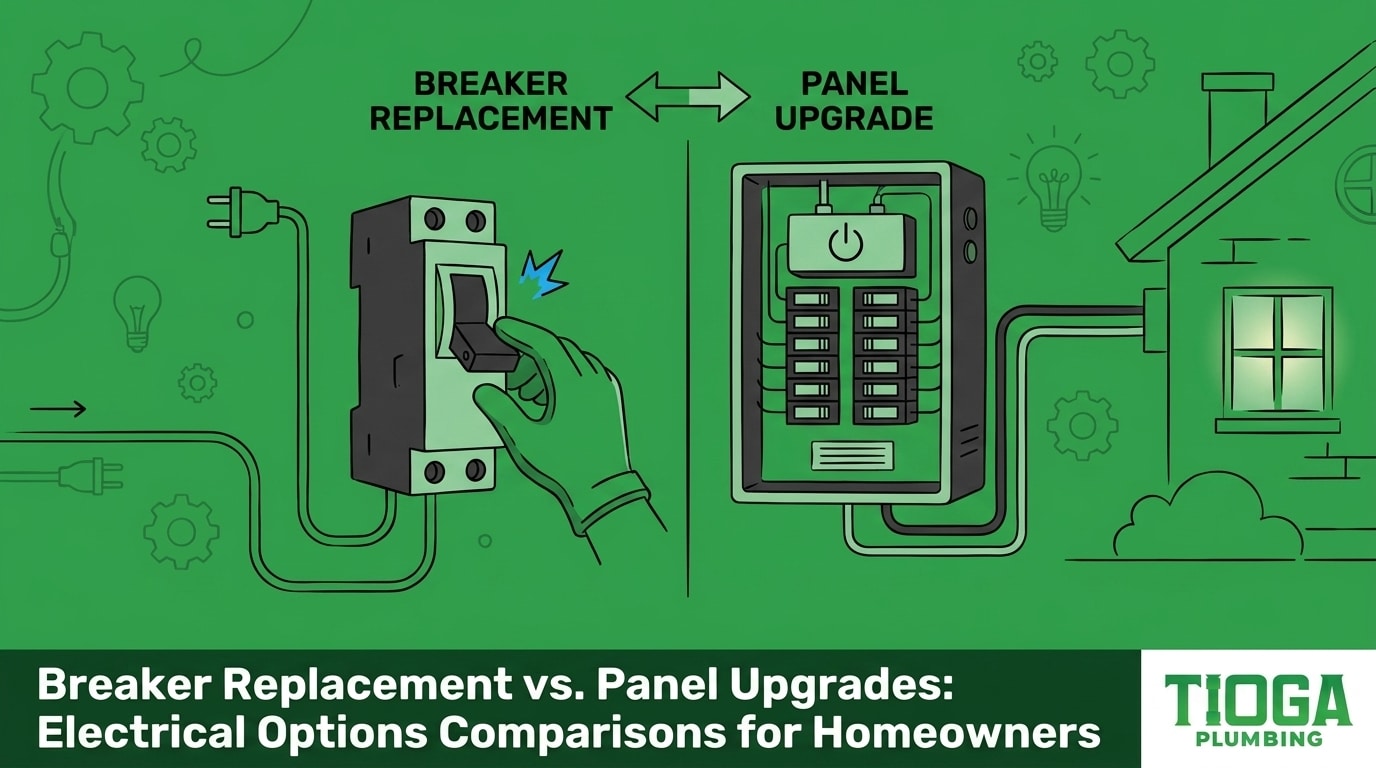
Breaker Replacement vs. Panel Upgrades: Electrical Options Comparisons for Homeowners
Is Your AC Constantly Tripping the Breaker in the Texas Heat? Are you finding yourself standing in front of your electrical panel every afternoon, flipping a tripped breaker just to keep your house cool? Losing your air conditioning during the July peak summer heat is more than just a minor inconvenience; it is a serious... Read more »
Got a $3,000+ Plumbing Quote? Get a Free Second Opinion
If another plumber handed you a quote of $3,000 or more, Tioga will come look at the same job for free and give you a written second opinion — even when the answer is that their price was fair.
Is the Gator Family Membership Worth $149 a Year?
One plan, $149 a year, ten inclusions. We do the arithmetic honestly — including who shouldn't buy it — and show where the membership pays for itself on a single service call.
How Plumbing Financing Works at Tioga (Step by Step)
Six steps from 'I can't pay for this today' to a scheduled repair. Tioga finances through Service Finance Company and Synchrony — a one-minute application that starts with a soft credit pull.
Water Softener vs. Whole-Home Filtration for DFW Homes
They solve different problems, and buying the wrong one is the most common water-treatment mistake we see. A side-by-side of what each removes, what it costs to run, and which DFW homes need both.
Drain Cleaning Cost in DFW: Auger vs. Hydro-Jetting
$185–$325 to auger one fixture, $285–$550 to clear a sewer main, $650–$1,200 to hydro-jet a lateral. Which one your symptoms call for, and why the cheapest option is sometimes the expensive one.

Taking a bite out ofYour Plumbing needs
We make fixing your home easier than ever. Whether it’s a leaky pipe, faulty wiring, or an urgent repair, our experts deliver fast, reliable solutions you can count on.